 By Graham Fisher
Updated November 2026
Stainless steel beer brewing pots are the workhorse kettles of home brewing, handling wort boils, mash runs and hot-side transfers without reacting with acidic liquids. This list compares six pots by capacity, bottom construction, included accessories and suitability for different batch sizes, with notes on what owners commonly report after real brew days.
Our top picks at a glance
- 1
 TOP CHOICEBest overallVEVOR Stainless Steel Kettle, 16 Gallon Brewing PotView on Amazon
- 2
 TOP CHOICEBest for full-size all-grain batches8 Gallon Brewers Best Basic Brewing PotView on Amazon
- 3
 TOP CHOICEBest for weldless fittingsCONCORD Stainless Steel Home Brew Kettle Stock Pot (Weldless Fittings) (30 QT/ 7.5 Gal)View on Amazon
- 4
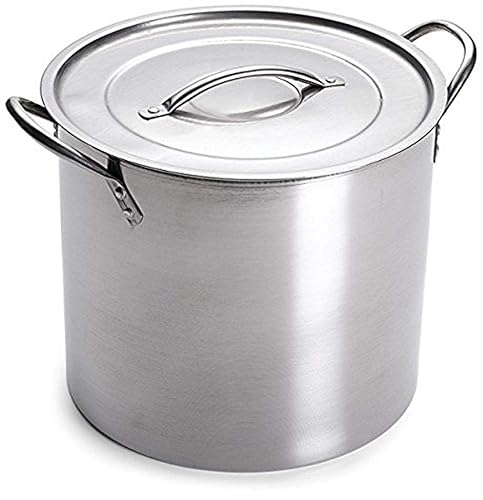 Best for simple stovetop batches5 Gallon Stainless Steel Stock Pot with Lid, 12.5 x 12.5 x 11.5View on Amazon
- 5
 Best for filtered transfersLeak-proof Stock Pot Homebrew Triple Filtration Beer Brewing Kettle wiView on Amazon
- 6
 Best budget pickHome Brew Ohio 20 Quart (5 Gallon) Economy Stainless Steel PotView on Amazon
Our Top Picks
| Product | Best for | Key feature |
|---|---|---|
| VEVOR Stainless Steel Kettle, 16 Gallon | Large all-grain batches | Tri-ply bottom, included accessories |
| 8 Gallon Brewers Best Basic Brewing Pot | Full-size batches | Standard 8-gallon capacity |
| CONCORD Home Brew Kettle (30 QT) | Builders adding valves | Weldless fittings |
| 5 Gallon Stainless Steel Stock Pot | Small stovetop batches | Lidded 5-gallon body |
| Triple Filtration Brewing Kettle (10 Gal) | Clear wort transfers | Triple filtration, ball valve |
| Home Brew Ohio 20 Quart Economy Pot | Beginners on a budget | Simple, no-frills body |
VEVOR Stainless Steel Kettle, 16 Gallon Brewing Pot
VEVOR Stainless Steel Kettle, 16 GALLON Brewing Pot, Tri Ply Bottom for Beer, Brew Kettle Pot, Home Brewing Supplies Includes Lid, Handle, Thermometer, Ball Valve Spigot, Filter, Filter Tray
Best for: Large all-grain batches with built-in accessories.
This kettle suits brewers who want to move up to bigger batches without buying a separate thermometer, spigot and filter. Owners often report the tri-ply bottom helps reduce scorching during the boil.
Pros
- Tri-ply bottom for more even heating
- Includes lid, handle, thermometer, ball valve and filter
Cons
- Large footprint for smaller stovetops
8 Gallon Brewers Best Basic Brewing Pot
8 Gallon Brewers Best Basic Brewing Pot
Best for: Full-size batches on a straightforward build.
A good fit for brewers who want a standard 8-gallon kettle and plan to add their own valve and thermometer over time.
Pros
- Standard 8-gallon capacity for full batches
- Simple body that is easy to clean
Cons
- Accessories must be purchased separately
CONCORD Stainless Steel Home Brew Kettle Stock Pot (Weldless Fittings) (30 QT/ 7.5 Gal)
CONCORD Stainless Steel Home Brew Kettle Stock Pot (Weldless Fittings) (30 QT/ 7.5 Gal)
Best for: Builders who want to add valves and sensors.
This kettle is aimed at brewers who plan to add a ball valve or temperature probe and want fittings that do not require welding.
Pros
- Weldless fittings simplify modifications
- 30-quart capacity suits 5-gallon batches comfortably
Cons
- Fittings are not included in some configurations
5 Gallon Stainless Steel Stock Pot with Lid, 12.5 x 12.5 x 11.5
5 Gallon Stainless Steel Stock Pot with Lid, 12.5 x 12.5 x 11.5
Best for: Small stovetop batches and extract brewing.
A practical choice for brewers making five-gallon extract batches on a standard range, with a lid for holding heat during the boil.
Pros
- Lid helps hold heat between additions
- Compact footprint for home stovetops
Cons
- No spigot or thermometer included
Leak-proof Stock Pot Homebrew Triple Filtration Beer Brewing Kettle with Ball Valve Spigot 10 Gal/40 QT
Leak-proof Stock Pot Homebrew Triple Filtration Beer Brewing Kettle with Ball Valve Spigot Rust-resistant 10 Gal/40 QT Brew Kettle Stainless Steel Brew Pot with Thermometer
Best for: Clearer wort transfers with built-in filtration.
Suited to brewers who want a kettle with a ball valve and filtration built in, especially for transferring wort with fewer grain particles.
Pros
- Triple filtration and ball valve spigot
- Includes a thermometer
Cons
- Filter components need regular cleaning
Home Brew Ohio 20 Quart (5 Gallon) Economy Stainless Steel Pot
Home Brew Ohio 20 Quart (5 Gallon) Economy Stainless Steel Pot
Best for: Beginners who want a simple, low-cost starter pot.
This is a no-frills option for first-time brewers who want a stainless pot for small batches without extra features.
Pros
- Simple design that is easy to learn on
- Economy option for first batches
Cons
- Minimal features, so accessories are extra
Buying Guide
Batch Size and Pot Capacity
Choose a pot that holds at least 1.5 times your target batch volume so you have room for a vigorous boil without boil-overs. Smaller 5 gallon pots suit extract brewing and partial boils, while 10 gallon and larger kettles are better suited to full-volume all-grain batches.
Bottom Construction and Heat Distribution
Look for a thick or tri-ply bottom, which spreads heat more evenly and reduces the risk of scorching wort on the bottom of the pot. An even heat profile matters most on electric and stovetop burners, where hot spots can cause caramelization and off-flavors.
Included Accessories and Valves
Many kettles come with a lid, thermometer, ball valve spigot, or filter tray. A ball valve makes draining and transferring wort easier, but check that any fittings are weldless or properly sealed to avoid leaks at the joints.
Steel Grade and Build Quality
Food-grade 304 stainless steel resists corrosion from acidic wort and cleaning chemicals better than lower grades. Pay attention to seam quality, handle strength, and how the lid seats, since these details affect both safety and daily usability.
FAQ
What size brew pot do I need for five gallon batches?
For a five gallon batch with a full boil, a pot in the 8 to 10 gallon range gives you comfortable headspace. A 5 gallon pot can work for partial boils or extract brewing, but it leaves little room for boil-overs. Matching the pot size to your batch volume is the simplest way to avoid spills.
Is a stainless steel pot safe for brewing beer?
Yes, food-grade stainless steel is widely used in home brewing because it is inert and does not leach metals into acidic wort. Clean and sanitize the pot thoroughly before each brew. Avoid abrasive pads that can scratch the surface and trap bacteria.
Do I need a ball valve spigot on my brew kettle?
A ball valve is not strictly required, since you can siphon or ladle wort out of the pot. However, a spigot makes transferring hot wort to a fermenter far easier and reduces the risk of splashing or oxygen exposure. Many brewers consider it a worthwhile feature for full-volume batches.
Can I use these pots on an induction cooktop?
Most stainless steel pots with a magnetic base work on induction cooktops, but compatibility depends on the specific construction of each pot. Check the manufacturer’s listing before buying if induction is your heat source. Make sure the pot base is flat for good contact with the burner.
How do I clean a stainless steel brew pot after use?
Rinse the pot promptly after draining to prevent residue from drying onto the surface. Use a non-abrasive cleaner and a soft sponge, then rinse thoroughly. Sanitize the pot before any contact with cooled wort or fermentation equipment.
Conclusion
If you brew full-volume all-grain batches and want the largest capacity, the 16 gallon and 10 gallon options are the best fit. For smaller batches, extract brewing, or a tighter budget, the 5 gallon and 8 gallon pots offer practical sizing without excess bulk.
Brewers who want a ready-to-use kit with a spigot, thermometer and filter should look at the more fully equipped models, while those who prefer a simple, durable pot can choose a basic stock-style kettle and add accessories as needed.
Related reading
- Home Brewing Stainless Steel Fermenter: A Step-by-Step Guide for Beginners
- 5 Best Home Brewing Equipment Stainless Steel Picks for 2026
- Yeast for Beer Brewing: A Step-by-Step Guide for Beginners
- What Equipment Do I Need for Home Brewing Beer? A Starter Guide
About Graham Fisher
Graham Fisher is part of our editorial team and reviews and edits our home brewing guides, checking product details against manufacturer specifications and owner feedback.


